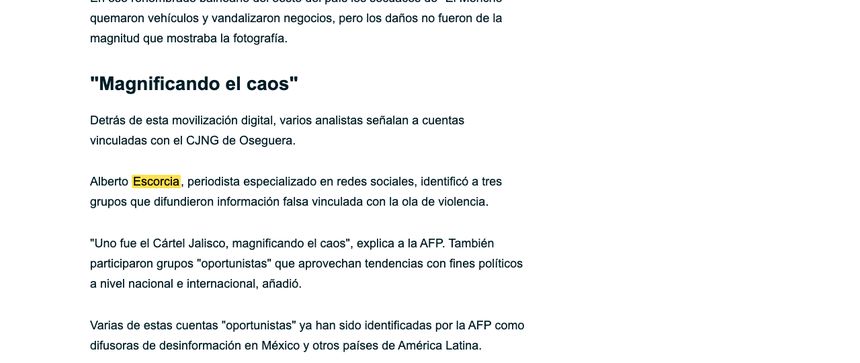
AFP (via France 24) · 26 feb 2026Desinformación en las redes, otra arma del Cártel Jalisco Nueva Generación
The agency’s original dispatch: it draws on his identification of three groups that spread false information during the violence.
This tool detected some 500 automated accounts that amplified CJNG cartel disinformation during the road blockades after the death of “El Mencho”. It was picked up by AFP, OCCRP, Milenio and La Opinión. Now you can do the same with your topic.
Boolean: AND/Y, OR/O, NOT/NO or -word, "exact phrase", parentheses and * for prefix. Example: (pemex OR huachicol*) AND -gasolina
Period: 29/09/2026 – 13/10/2026 · the whole captured conversation
Each dot is an account; its size is how much amplification it receives and its color is the category the classifier assigns. Lines show who retweets or mentions whom. Communities pull apart on their own because of how each group operates (ForceAtlas2, the same algorithm as Gephi). Height is time: accounts that appear later sit higher. Drag to rotate the 3D graph and zoom with the wheel. The public version shows the names of the 60 most amplified accounts; the full network, with every account and its figures, comes in the CSV.
Automated amplification reading. It is a guide to decide where to look, not a verdict.
No strong signals of concentrated amplification in this range.
Each post is classified using seven behavioral criteria of the account. It is a presumptive reading: signals, not conclusions.
Accounts most mentioned or retweeted by the activity of each category. The % is their share of all mentions and retweets made from that category.
Housing and encampments: coordinated accounts show up before organic ones (p=0.006) and the non-organic share drops as volume rises. @eldiarioes, second most amplified account.
The analysis picked up by AFP, OCCRP, La Opinión and Milenio: a highly concentrated core and 42.5 % non-organic activity.
🔓 Every analysis is published under Recent analyses, like a pastebin. With full access they are private.
THEVERIFICATOR.NET is a forensic analysis tool for influence operations on social media, built by journalist Alberto Escorcia (@AlbertoEscorcia). It detects coordinated inauthentic behavior from how the conversation moves: who posts, who amplifies, at what pace and in which groups.
The code, the full methodology and the backups live in the project’s private repository, documented so it can be rebuilt.
Public viewer of the last 90 days of X/Twitter conversation with aggregates, activity bursts and the amplification network. No API and no post listings; the CSV (US$ 50) and the top 100 (US$ 100) are paid one-time downloads. Every search is published under “Recent analyses”; with full access (US$ 100 per month) your space is private.
Articles on the disinformation that followed reports of the death of “El Mencho” that cite Alberto Escorcia’s analysis. Screenshots of the passage, linked to each original; only articles verified by opening them are included.
The agency’s original dispatch: it draws on his identification of three groups that spread false information during the violence.
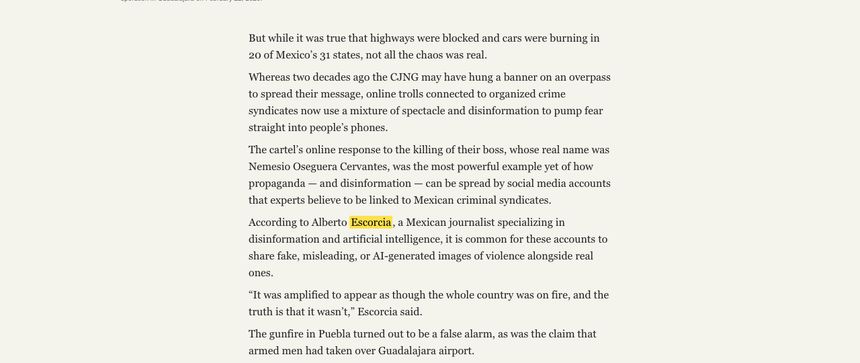
The international consortium’s feature: it uses his tracing of fake images back to cartel-linked accounts and his explanation of how algorithms are manipulated.
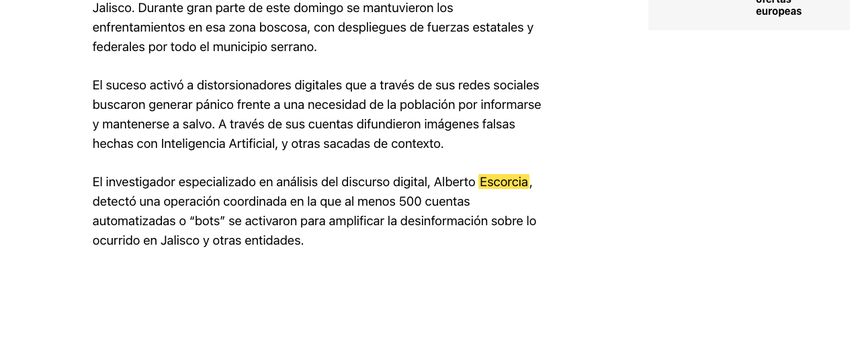
Reports his finding of some 500 automated accounts that amplified the disinformation.
AFP’s English-language coverage, with his analysis of the three groups.
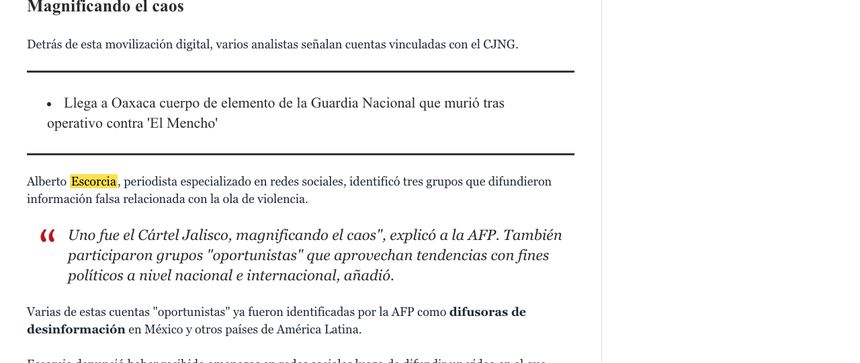
AFP’s Spanish-language coverage, with his analysis of the three groups.
The agency’s Spanish version published by Animal Político.
Summarizes the OCCRP feature and includes his explanation of how criminal networks manipulate algorithms.
Draws on his analysis of who amplified the disinformation, including the role of influencers.
Cites his detection of more than 500 automated accounts that amplified false information.
Alberto Escorcia is a journalist who has investigated online disinformation since 2009. He worked with BuzzFeed and LoQueSigue, and runs THEVERIFICATOR.NET.
Its author has produced analyses for platform teams at Twitter, Google and Facebook, who checked them against their own tools and reached the same conclusions.
The tool measures with fixed, reproducible rules: the same search over the same period gives the same result, and every figure can be audited.
What it finds are behavioral signals, not a verdict on who is behind an account: they tell you where to look and what to verify. Before publishing a finding, check it against other sources, as was done in the El Mencho case.