

Context: What People Are Actually Searching
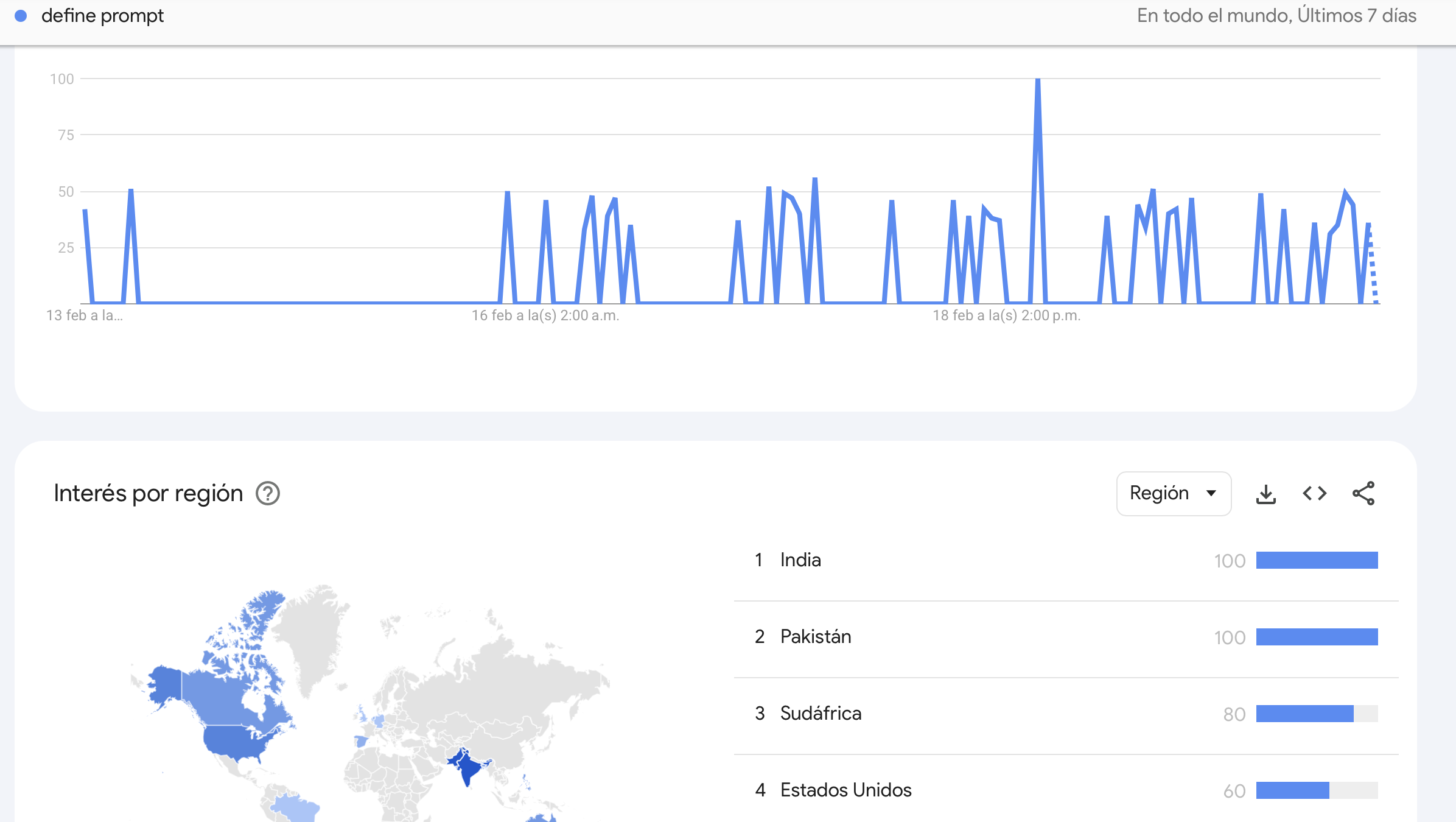
The term “define prompt” (+300%) does not grow in isolation. It sits inside a larger surge of AI-related queries:
-
“AI image detector”
-
“humanize AI free”
-
“prompt engineering salary”
-
“how much water does AI use per prompt”
This is not curiosity about a gadget. It is a literacy wave.
People are not asking how to hack the system. They are asking what the system is.
Why Now?
Three forces converge:
-
Mass adoption of generative AI tools
-
Professionalization of prompting
“Prompt engineering salary” rising alongside definitional queries signals career anxiety and opportunity scanning.
-
Detection & authenticity pressure
Queries such as “AI detector” and “humanize AI” reflect fear of being flagged, replaced, or exposed.
The public conversation shifted from “What can AI do?” to “How does it actually work — and what does it mean for me?”
What the Data Pattern Shows
The growth curve shows three simultaneous behaviors:
-
Educational intent (define, synonym, meaning)
-
Optimization intent (engineering, repetition techniques)
-
Ethical/environmental concern (water use per prompt)
This combination suggests a transition from novelty to integration.
We are past experimentation. We are in normalization.
What Anxiety Is Driving This?
At its core, “define prompt” is not linguistic curiosity.
It signals:
-
Fear of irrelevance in the labor market
-
Desire to master a new interface language
-
Concern about authenticity (human vs AI)
-
Emerging environmental awareness
When a society starts defining the vocabulary of a technology, it is preparing to negotiate power around it.
What Is a Prompt (Briefly)?
A prompt is an instruction or input given to an AI model to generate an output.
In generative systems, the prompt defines boundaries, tone, structure, and constraints.
It is not just a question — it is the architecture of the answer.
What This Search Pattern Reveals
The surge tells us something deeper:
We are witnessing the standardization of AI literacy.
Just as “Google it” became cultural shorthand in the 2000s, prompt-writing is becoming a cognitive skill people believe they must acquire.
The rise in definitional searches is what happens before a technology becomes invisible infrastructure.
People search to understand.
Then they normalize.
Then they depend.
And when dependency begins, the vocabulary stabilizes.
Context: What People Are Searching
Searches for:
-
“AI detector”
-
“AI image detector”
-
“humanize AI free”
are rising together.
This is not a coincidence. It is behavioral symmetry.
When generative AI tools became accessible through companies like OpenAI and Google, creation became easier. But simultaneously, institutions responded with verification systems.
Creation expanded. Surveillance followed.
Why This Surge Is Happening Now
Three pressures are converging:
1. Academic Enforcement
Schools increasingly deploy AI detection tools in plagiarism systems (e.g., Turnitin).
Students are not just asking how to use AI — they’re asking how to avoid being flagged.
2. Workplace Authenticity
Employers worry about automated content. Freelancers worry about being replaced.
Searches like “humanize AI free” reveal defensive behavior: people want AI assistance without detection penalties.
3. Platform Moderation
Social networks and publishing platforms experiment with labeling AI-generated content. The social cost of being “exposed” has increased.
Detection anxiety rises when norms are unclear.
What the Pattern Shows
Unlike hype-driven spikes, detection searches show sustained growth, which signals structural integration.
We see three behavioral stages:
-
Use AI
-
Fear consequences
-
Search for protection
This is not anti-AI behavior. It is adaptation behavior.
At its core, this trend reflects:
-
Fear of academic punishment
-
Fear of reputational damage
-
Fear of losing professional legitimacy
-
Confusion about fairness of detection systems
It’s less about cheating — more about control.
When technology becomes invisible in output, society demands visible proof of authorship.
What AI Detectors Actually Do (Briefly)
Most AI detectors analyze:
-
Predictability patterns
-
Perplexity and burstiness
-
Statistical likelihood of token sequences
They do not “understand” authorship.
They calculate probability.
And that uncertainty fuels anxiety.
What This Reveals
The rise in detection searches signals a transition from experimentation to regulation.
People are no longer asking “Can AI write this?”
They’re asking “Will I be punished for it?”
That shift marks institutional normalization.
References / Sources
-
https://trends.google.com
-
https://openai.com
-
https://www.anthropic.com